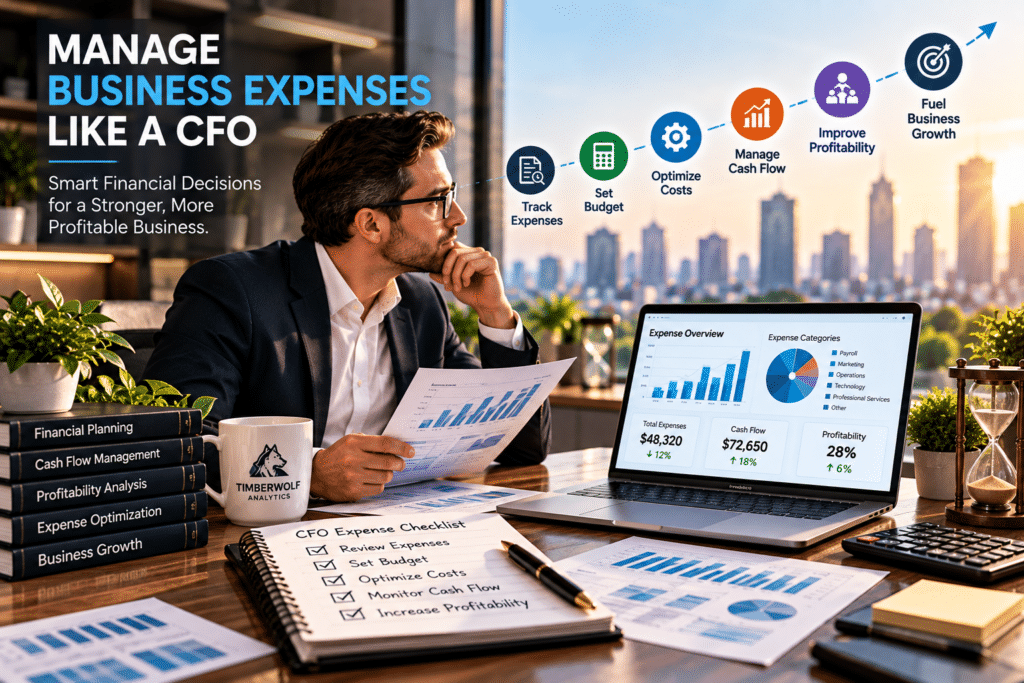
Managing business expenses is not simply about spending less money. For a healthy business, the goal is to understand where money is going, why it is being spent, what value it creates, and whether the business can support those costs over time.
This is where a CFO mindset can make a difference.
A CFO looks beyond individual expenses and considers the relationship between costs, revenue, profitability, cash flow, working capital, and future growth. Instead of cutting expenses across the board, the focus is on making informed financial decisions that protect the business while supporting its goals.
For small and growing businesses, effective expense management can improve financial visibility, protect cash flow, and create a stronger foundation for sustainable growth.
What Is Business Expense Management?
Business expense management is the process of tracking, reviewing, budgeting, controlling, and optimizing the money a company spends to operate.
Common business expenses include:
- Payroll and employee costs
- Rent and office expenses
- Marketing and advertising
- Software and technology
- Professional services
- Insurance
- Inventory and supplies
- Travel and business development
- Loan and financing costs
- Taxes and other operating expenses
Effective expense management does not mean eliminating every cost. Some expenses are necessary to generate revenue, improve operations, serve customers, or support growth.
The objective is to make sure each significant expense has a clear business purpose and fits within the company’s financial capacity.
Why Managing Business Expenses Matters
Expenses directly affect profitability, but their impact goes beyond the income statement.
A business may generate strong revenue while experiencing financial pressure because operating costs are increasing faster than sales. Similarly, a profitable company can still face cash shortages when money is tied up in accounts receivable, inventory, or other working capital.
That is why expense decisions should be connected to the broader financial picture.
A CFO-style approach considers three questions:
- Can we afford this expense?
- What financial or operational value will it create?
- How will this decision affect future cash flow and profitability?
Answering these questions helps business owners move from reactive spending to structured financial management.
10 CFO Strategies to Manage Business Expenses
1. Review Your Expenses Regularly
You cannot manage what you cannot clearly see.
Start by reviewing your financial records and categorizing expenses into meaningful groups. Look for recurring costs, unusual increases, duplicate subscriptions, unused services, and expenses that no longer support current business goals.
A monthly expense review can reveal changes that may otherwise go unnoticed.
The goal is not to question every small transaction. Focus first on the expenses that have a meaningful effect on profitability or cash flow.
2. Separate Fixed and Variable Costs
Understanding your cost structure makes financial planning easier.
Fixed costs generally remain relatively stable over a period, such as rent, insurance, or certain software subscriptions.
Variable costs change with business activity, such as transaction fees, shipping, materials, commissions, or production costs.
Separating these costs helps you understand how expenses may change when revenue increases or decreases.
For example, a business with high fixed costs may require stronger revenue consistency to remain profitable, while a business with more variable costs may have greater flexibility during slower periods.
3. Create a Realistic Expense Budget
A budget provides a financial framework for spending decisions.
Instead of simply setting arbitrary expense limits, build your budget around realistic revenue expectations, historical performance, operational requirements, and business goals.
A useful expense budget can include:
- Payroll
- Marketing
- Technology
- Professional services
- Operations
- Insurance
- Equipment
- Taxes
- Debt payments
- Planned investments
You should also review your budget against actual results. A budget that is never compared with real performance becomes less useful over time.
4. Compare Budgeted vs. Actual Expenses
One of the most useful CFO practices is variance analysis.
Compare what you expected to spend with what you actually spent.
For example, if your monthly technology budget is $5,000 but actual spending reaches $7,500, the key question isn’t simply why spending increased. You also need to determine whether the additional $2,500 produced additional value.
Possible reasons for a variance include:
- Higher customer demand
- Unexpected operational costs
- New employees
- Price increases
- One-time purchases
- Poor expense controls
- Changes in business strategy
Regular budget-versus-actual analysis helps identify patterns and allows management to respond before small problems become larger financial issues.
5. Review Vendors, Subscriptions, and Contracts
Recurring expenses deserve special attention because they can continue accumulating without receiving much attention.
Review your:
- Software subscriptions
- Supplier agreements
- Insurance policies
- Professional services
- Payment processing fees
- Communication services
- Advertising contracts
Ask whether each service is still necessary, whether the pricing remains competitive, and whether the business is using the service fully.
However, cost should not be the only consideration. Replacing a reliable supplier with a cheaper alternative may create quality problems, delays, or operational risk.
Good expense optimization considers both cost and business value.
6. Improve Accounts Payable Management
Managing expenses also means managing when you pay bills.
Accounts payable management helps businesses understand upcoming obligations and plan cash requirements more effectively.
This does not mean delaying payments irresponsibly. Instead, businesses should establish clear payment processes, monitor due dates, avoid unnecessary late fees, and maintain healthy supplier relationships.
When accounts payable is managed alongside cash flow forecasting, business owners can make better decisions about when cash will be required.
7. Protect Cash Flow While Controlling Costs
Expense management and cash flow management are closely connected.
A business can reduce expenses and still experience cash-flow problems if customer payments are delayed Manage Business or major financial commitments are poorly timed.
This is why owners should look beyond the expense itself and consider when cash leaves the business.
For example, a large annual payment may be cheaper overall than monthly payments, but it can create a significant short-term cash requirement.
A cash flow forecast helps businesses anticipate future inflows Manage Business and outflows rather than relying only on the current bank balance.
8. Track Financial KPIs That Explain Expense Performance
Financial KPIs can help business owners understand whether Manage Business expenses are supporting healthy financial performance.
Useful metrics may include:
- Gross profit margin
- Net profit margin
- Operating expenses
- Operating cash flow
- Working capital
- Accounts receivable days
- Budget versus actual spending
- Break-even point
The important point is not to track dozens of numbers. Choose Manage Business KPIs that help answer meaningful business questions.
For example:
Are expenses growing faster than revenue?
Are operating costs reducing our margins?
Is cash flow strong enough to support planned investments?
Are rising expenses producing measurable business value?
Tracking the right financial KPIs turns expense management from basic bookkeeping into a decision-making process.
9. Connect Expenses to Profitability
Don’t judge every expense simply by whether it can be reduced.
A better question is whether the expense contributes to revenue, Manage Business efficiency, customer Manage Business experience, risk management, or long-term growth.
For example, increasing marketing spend may make sense if it brings in profitable customers. Hiring another employee may be appropriate if additional capacity allows the company to serve more customers profitably.
This is why expense optimization should always be connected to profitability analysis.
The objective is not minimum spending.
The objective is efficient Manage Business spending that supports sustainable profitability.
10. Use Financial Forecasting Before Making Major Spending Decisions
Before committing to a major expense, consider how the decision could affect the business over the next several months.
A financial forecast can help evaluate decisions such as:
- Hiring employees
- Opening a new location
- Purchasing equipment
- Increasing marketing investment
- Taking on debt
- Launching a new product
- Expanding into another market
A strong financial plan connects expenses with revenue expectations, Manage Business cash requirements, profitability, KPIs, and potential risks.
This allows business owners to evaluate not only whether they can afford an expense today, but whether they can comfortably support it in the future.
Business Expense Management vs. Simply Cutting Costs
Cost cutting and expense management are not the same thing.
Cost cutting focuses primarily on reducing spending.
Expense management takes a broader view.
For example, cutting employee training may reduce short-term Manage Business costs but could affect productivity or retention. Reducing marketing may improve immediate profitability but could also slow future revenue growth.
A CFO evaluates the potential trade-offs before recommending a change.
The right question is:
Which expenses should we reduce, which should we maintain, and which should we increase because they create measurable value?
This approach helps protect the business from short-term decisionsManage Business that may create larger problems later.
How Cash Flow, Working Capital, and Expenses Work Together
Business expenses do not exist in isolation.
They interact with accounts receivable, accounts payable, inventory, cash balances, and other working capital components.
For example, a company may record $100,000 in revenue but have a significant portion of that money tied up in unpaid customer invoices. At the same time, the company still needs to pay payroll, suppliers, rent, and other expenses.
This creates a gap between reported profitability and available cash.
Effective working capital management helps business owners understand these relationships and plan accordingly.
Expense management becomes much more effective when it is combined with cash flow forecasting and working capital analysis.
How to Build a Business Expense Management Plan
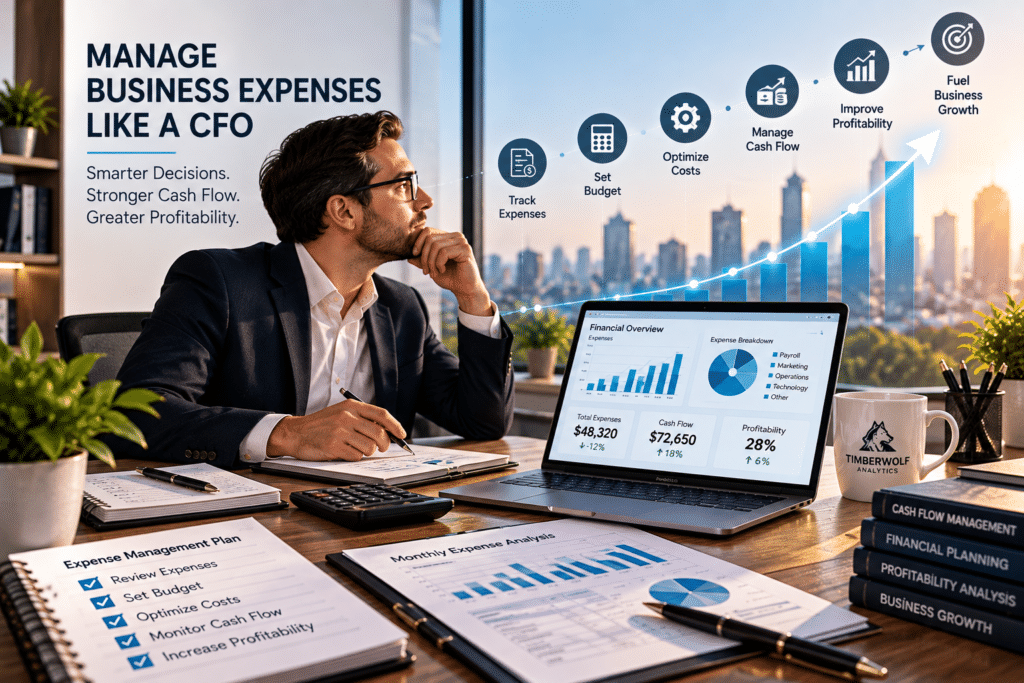
A practical expense management plan can follow these steps:
Step 1: Establish Accurate Financial Records
Start with reliable bookkeeping and reconciled financial records. Poor data can lead to poor decisions.
Step 2: Categorize Expenses
Separate expenses into fixed, variable, operational, administrative, and strategic.
Step 3: Identify Major Cost Drivers
Determine which expenses have the largest impact on profitability and cash flow.
Step 4: Create Spending Targets
Build realistic budgets based on historical results and future business expectations.
Step 5: Monitor Actual Performance
Compare actual expenses with your budget every month.
Step 6: Investigate Significant Variances
Understand why spending changed before deciding whether action is necessary.
Step 7: Forecast Future Cash Requirements
Evaluate how planned expenses will affect future cash availability.
Step 8: Review and Adjust
Business conditions change. Your expense management plan should change with them.
When Should a Business Consider Fractional CFO Support?
As a business grows, financial decisions often become more complex.
Owners may spend too much time reviewing financial reports, managing cash flow, preparing budgets, analyzing profitability, or deciding whether the company can afford its next major investment.
This is where a Fractional CFO can provide strategic financial support.
A Fractional CFO can help connect bookkeeping and financial reporting with forecasting, budgeting, profitability analysis, financial KPIs, cash flow management, and long-term planning.
The objective is not simply to report what happened. It is to help management understand what the numbers mean and what decisions may need to come next.
Frequently Asked Questions
How do you manage business expenses effectively?
Start by maintaining accurate financial records, categorizing expenses, creating a realistic budget, comparing actual spending with expectations, reviewing recurring costs, and forecasting future cash requirements.
How can a small business reduce unnecessary expenses?
Review recurring subscriptions, vendor contracts, administrative costs, and other major spending categories. Before cutting an expense, evaluate whether it contributes to revenue, efficiency, customer service, compliance, or long-term growth.
What is the difference between expense management and cost cutting?
Cost cutting focuses primarily on reducing spending. Expense management evaluates spending based on its financial impact, business value, cash-flow requirements, and contribution to long-term profitability.
What financial metrics should business owners monitor?
Useful metrics include gross profit margin, net profit margin, operating cash flow, working capital, days sales outstanding, operating expenses, budget-to-actual results, and the break-even point. The most useful KPIs depend on the business model and goals.
Can expense management improve cash flow?
Yes. Better expense planning can help businesses control unnecessary spending, anticipate upcoming payments, manage payment timing, and identify future cash requirements. However, cash flow also depends on factors such as customer collections, inventory, financing, and working capital.
When should a small business hire a Fractional CFO?
A business may consider Fractional CFO support when financial decisions become more complex, cash flow is difficult to forecast, profitability is unclear, the company is growing quickly, or the owner needs more strategic financial guidance.
Final Thoughts
Managing business expenses like a CFO is not about making the business spend as little as possible.
It is about making better financial decisions.
A strong expense management process connects accurate bookkeeping with budgeting, financial reporting, cash flow forecasting, profitability analysis, working capital management, and financial KPIs.
Start by understanding where your money is going. Then determine which expenses create value, which costs need closer attention, and how current spending could affect future cash flow and profitability.
When financial data is accurate and connected to a clear plan, business owners can make spending decisions with greater confidence and build a stronger foundation for sustainable growth.