Tax season can be stressful for small business owners, especially when financial records are incomplete, receipts are missing, or business expenses have not been properly categorized. Preparing early helps you organize your financial information, understand your filing responsibilities, and reduce avoidable errors.
For small businesses in the USA, tax preparation involves more than completing forms. It also requires accurate bookkeeping, supporting documents, a review of eligible deductions, and an understanding of federal, state, and local requirements.
This guide explains how to prepare your business records, identify commonly required tax forms, review potential deductions, and establish a practical tax preparation checklist for 2026.
Important: The 2026 federal filing season generally covered individual returns for the 2025 tax year. The regular federal filing deadline for most calendar-year individual taxpayers was April 15, 2026. If you received an extension, remember that an extension to file generally does not extend the deadline to pay tax owed.
What Is Small Business Tax Preparation?
Small business tax preparation is the process of organizing financial records, reviewing income and expenses, identifying applicable deductions, and preparing the tax forms required for a business and its owner.
The exact process depends on the business structure. A sole proprietor generally reports business income on an individual return, while a partnership, S corporation, or C corporation may have different filing requirements.
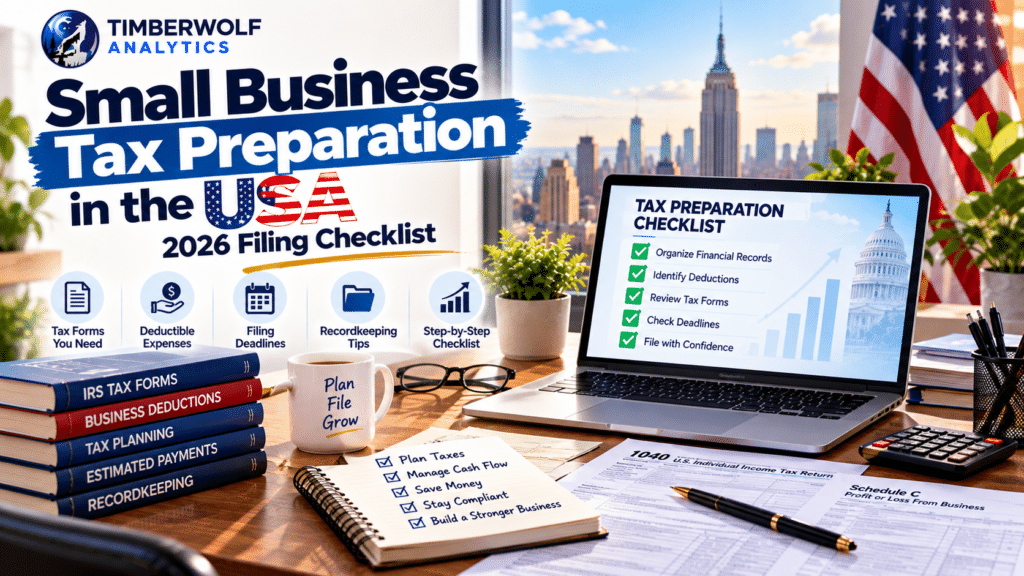
A typical tax preparation process includes:
Reviewing business income and expenses.
Reconciling bank and credit card accounts.
Collecting receipts, invoices, and supporting documents.
Identifying potentially deductible business expenses.
Preparing the applicable federal tax forms.
Reviewing state and local filing obligations.
Calculating payments and checking filing deadlines.
Accurate records make each step easier and provide a more reliable picture of your business finances.
1. Organize Your Financial Records Before Filing
The first step in tax preparation is gathering complete and accurate financial information for the relevant tax year.
Start by collecting bank statements, credit card statements, sales records, customer invoices, expense receipts, loan statements, and applicable tax forms. If you use accounting software, review the records to identify missing transactions and uncategorized expenses.Use this checklist:
Gather business bank and credit card statements.
Collect sales invoices and payment records.
Organize receipts for business purchases.
Review contractor payments and relevant Forms 1099.
Record equipment purchases and other business assets.
Reconcile accounts and investigate discrepancies.
Review outstanding customer invoices and unpaid bills.
Save supporting documents in a secure, organized location.
Why bookkeeping matters for tax preparation
If transactions are missing or expenses are categorized incorrectly, your financial reports may not accurately reflect business performance. That can make tax preparation more complicated and create questions about the information reported.
TimberWolf Analytics provides bookkeeping services for small businesses to help organize transactions, reconcile accounts, and maintain reliable financial records.
2. Understand Which Tax Forms Your Business May Need
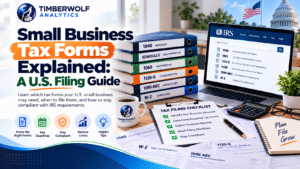
The forms required depend on your business structure, income, and tax circumstances. Here are some common federal forms to understand.
Form 1040: Individuals generally use this form to file their federal income tax returns.
Schedule C: Sole proprietors generally use Schedule C to report business income and deductible expenses and calculate business profit or loss.
Schedule SE: Self-employed individuals generally use this schedule to calculate self-employment tax when required.
Form 1065: Partnerships generally use this form to report partnership income, deductions, and other information.
Form 1120-S: S corporations generally use this form to report their income, deductions, and other tax information.
Form 1120: C corporations generally use this form to report corporate income, deductions, and tax liability.
These forms serve different purposes and are not interchangeable. Some businesses may need additional schedules or information returns.
For authoritative instructions, visit the Internal Revenue Service (IRS). If you are uncertain which forms apply to your business structure, consult a qualified tax professional.
3. Review Potentially Deductible Business Expenses
Eligible business deductions may reduce taxable business profit. Generally, an expense must be ordinary and necessary for conducting the business, and special rules may apply depending on the expense.
Common categories to review include:
Advertising and marketing: Qualifying costs for promoting products or services.
Office supplies: Eligible stationery, printing, and other business supplies.
Software and subscriptions: Applications and tools used for business activities.
Professional services: Qualifying bookkeeping, accounting, legal, and consulting fees.
Business insurance: Eligible premiums for business-related coverage.
Contract labor: Qualifying payments to independent contractors.
Travel and vehicle expenses: Eligible business-use costs supported by appropriate records.
Equipment: Qualifying purchases handled under applicable expensing or depreciation rules.
Home office expenses: Costs that meet the IRS requirements for business use of a home.
Not every expense is fully deductible. Personal expenses generally cannot be claimed as business expenses, and limitations may apply to meals, vehicles, travel, equipment, and expenses involving both personal and business use.
Do not claim a deduction solely because a purchase was made using a business bank account. Keep supporting documentation and review the relevant IRS rules before filing.
4. Check Your Tax Filing Deadlines
Missing a filing or payment deadline can result in penalties or interest, depending on the circumstances. Business owners should identify the deadlines applicable to their tax structure and filing year.
For many calendar-year individual taxpayers, the regular federal deadline for filing a 2025 individual income tax return was April 15, 2026. A valid extension generally gives eligible taxpayers additional time to file, often until October 15, 2026, but it does not automatically extend the time to pay tax owed.
Business entities may have different filing deadlines. Estimated tax payments also follow their own schedule.
If you are preparing for a future filing period, verify the deadlines for that specific tax year rather than relying on dates from an older article. Weekend and legal-holiday rules, disaster relief, and other special circumstances can affect deadlines.
Check the IRS tax calendar and filing guidance for current information.
5. Review Estimated Tax Payments
Some small business owners need to pay estimated federal taxes during the year because tax is not automatically withheld from their business income.
Estimated payments may cover anticipated income tax and self-employment tax. Whether payments are required depends on your expected tax liability, withholding, credits, and other applicable rules.
Review these items:
Your expected business profit for the year.
Federal income tax already withheld or paid.
Self-employment tax, if applicable.
Estimated payments previously submitted.
Changes in revenue or expenses that may affect your tax liability.
For many individual taxpayers, estimated payments may be required when they expect to owe at least $1,000 after withholding and refundable credits, subject to IRS rules and exceptions.
Do not assume that a profitable business automatically has enough cash available to cover its tax obligations. Keep tax payments in your cash flow plan and consult the IRS instructions or a qualified tax professional if your circumstances are complex.
6. Reconcile Your Accounts and Review Financial Reports
Before completing your return, compare your accounting records with bank statements, credit card statements, payment processor reports, and other relevant documents.
Investigate unexplained differences rather than making unsupported adjustments. Check for duplicate entries, missing deposits, uncategorized expenses, and transactions recorded in the wrong period.
Review your main financial statements:
Profit and loss statement: Helps you review revenue, expenses, and business profit or loss.
Balance sheet: Shows business assets, liabilities, and equity at a specific date.
Cash flow statement: Helps explain how cash moves into and out of the business.
These reports can reveal issues that are not obvious from the bank balance alone. For example, a business may show a profit while experiencing cash pressure because customers have not paid their invoices.
TimberWolf Analytics also provides cash flow forecasting resources to help businesses plan for upcoming financial commitments and improve visibility into future cash needs.
7. Consider Professional Tax Preparation Support
Some business owners can prepare straightforward returns themselves using appropriate tax software and current IRS instructions. Others may benefit from professional assistance, particularly when their finances involve multiple income sources, employees, business assets, complex deductions, or several state filing obligations.
Professional support may be useful when:
Your bookkeeping is incomplete or significantly behind.
You are uncertain which tax forms apply to your business.
You have questions about deductions or asset purchases.
Your business operates in multiple states.
You need help reviewing complex transactions.
You want to organize records before meeting with a CPA or tax professional.
Tax preparation and bookkeeping are related but distinct. Bookkeeping organizes financial transactions and maintains records; tax preparation uses the relevant financial information to prepare required tax filings.
TimberWolf Analytics explains its approach to tax preparation services for small businesses. If your records need cleanup first, its catch-up bookkeeping services can help organize historical transactions and prepare financial records for review.
Confirm which services a provider actually performs and whether a qualified tax professional will prepare or review your return.
8. Build a Tax Preparation Routine for the Year
The easiest way to reduce tax-season stress is to make financial organization part of your regular business operations.
Monthly: Record transactions, save receipts, reconcile bank accounts, and review financial reports.
Quarterly: Review estimated tax payments, evaluate cash flow, and check upcoming tax obligations.
Before filing: Gather tax forms, verify income, review deductions, investigate discrepancies, and confirm deadlines.
After filing: Save a copy of the return, retain supporting records, and note any follow-up actions or payments.
The IRS provides recordkeeping guidance explaining how documents such as receipts, invoices, bank statements, and other supporting records help substantiate business income and expenses. Retention periods vary by record type and circumstances, so check the applicable requirements rather than assuming one period applies to everything.
Frequently Asked Questions
What documents do small businesses need for tax preparation?
Common documents include income records, expense receipts, bank statements, credit card statements, applicable Forms 1099, asset purchase records, and previous tax returns. The exact requirements depend on your business structure and circumstances.
Can small businesses prepare their own tax returns?
Yes. Some owners with straightforward finances can prepare their own returns using suitable tax software and official IRS instructions. Professional assistance may be useful when the business has complex transactions, employees, multiple state obligations, or uncertain deductions.
What happens if a business misses a tax deadline?
Possible consequences include penalties and interest, depending on the filing or payment obligation and the circumstances. If you missed a deadline, review the applicable IRS guidance promptly and consider consulting a qualified tax professional.
Why is bookkeeping important before tax season?
Bookkeeping organizes income, expenses, and financial transactions so that the information used for tax preparation is more complete and reliable. Reconciled accounts and supporting documents also make it easier to investigate discrepancies.
Does every small business pay estimated taxes quarterly?
No. Estimated tax requirements depend on the owner’s or entity’s circumstances, expected liability, and applicable rules. Check the relevant IRS guidance to determine whether payments are required.
Final Thoughts
Small business tax preparation in the USA is easier when you maintain accurate records throughout the year, understand the forms applicable to your business, document eligible expenses, and plan for tax payments.
Start with a financial records review, reconcile your accounts, gather supporting documents, and verify filing requirements for the correct tax year. When your finances are complex or your records are behind, qualified professional support can help you prepare more confidently.
TimberWolf Analytics helps small businesses organize bookkeeping, improve financial reporting, and gain clearer visibility into cash flow. Explore our financial services to learn how organized financial records can support better business decisions.