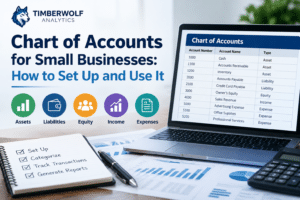
A small business needs more than a record of money coming in and going out. To understand profitability, control expenses, and make informed financial decisions, business owners need a clear system for organizing financial transactions.
A chart of accounts for small business provides that structure. It is a list of the accounts a business uses to classify transactions and prepare financial reports. When set up correctly, it helps business owners understand what they own, what they owe, how much they earn, and where their money goes.
Without a well-organized chart of accounts, similar transactions may be recorded under different categories, expenses can become difficult to compare, and financial reports may provide limited insight.
This guide explains what a chart of accounts is, which categories to include, how to set one up, and how to maintain it as your business grows.
What Is a Chart of Accounts?
A chart of accounts (COA) is an organized list of financial accounts used in a bookkeeping or accounting system. Each account represents a specific type of asset, liability, equity, revenue, or expense.
Think of it as the filing system for your business finances. When a transaction occurs, it is assigned to the appropriate account so it can be summarized accurately in financial reports.
For example:
Money received from customers is generally recorded in a revenue account.
Rent paid for business premises is usually recorded in a rent expense account.
Money held in a business bank account is recorded as an asset.
An outstanding business loan is recorded as a liability.
The chart of accounts does not replace invoices, receipts, bank statements, or transaction records. Instead, it provides a consistent structure for organizing the information those documents support.
If you are new to financial recordkeeping, start with our guide to bookkeeping basics for small business owners.
Why Is a Chart of Accounts Important?
A well-designed chart of accounts helps you turn individual transactions into useful financial information.
1. Better financial reporting: Proper categorization makes it easier to prepare income statements and balance sheets.
2. Clearer expense tracking: Separate accounts help you identify how much you spend on payroll, software, marketing, rent, and other operating costs.
3. More consistent bookkeeping: A standard structure reduces confusion about where transactions should be recorded.
4. Easier budgeting: Historical spending and revenue figures provide a stronger starting point for future budgets.
5. More informed decisions: Organized financial information helps owners evaluate costs, profitability, and operational changes.
6. More organized tax preparation: Consistent records can help you gather information needed for tax reporting, although account categories alone do not determine whether an expense is tax-deductible.
The IRS explains that good business records support financial statements, help track income and expenses, and provide documentation for tax returns. See its official recordkeeping guidance.
The Five Main Chart of Accounts Categories
Most small business charts of accounts use five main categories. The exact accounts within each category depend on the business model, reporting requirements, and level of detail needed.
1. Assets
Assets are resources the business owns or controls that have economic value.
Common asset accounts include:
Business checking and savings accounts
Accounts receivable
Inventory
Equipment and machinery
Computers and office furniture
Prepaid expenses
Accumulated depreciation as a contra-asset account
For example, if your company purchases a computer for business use, the transaction may be recorded as equipment rather than immediately classified as an ordinary operating expense. The appropriate accounting treatment depends on the facts and applicable accounting policy.
2. Liabilities
Liabilities represent amounts the business owes to other parties.
Typical liability accounts include:
Accounts payable
Business loans payable
Credit card balances payable
Accrued expenses
Payroll liabilities
Sales tax payable, where applicable
Unearned or deferred revenue, when appropriate
Separating liabilities from expenses is important. Receiving a loan creates a liability; it does not normally create revenue. Similarly, paying down the principal on a loan reduces the liability, while interest is generally recorded separately as an expense.
3. Equity
Equity represents the owners’ residual interest in the business after liabilities are subtracted from assets.
Depending on the business structure, accounts may include:
Owner’s capital
Owner contributions
Owner draws or distributions
Common stock
Additional paid-in capital
Retained earnings
The right equity accounts depend on whether the business is a sole proprietorship, partnership, LLC, or corporation and how it is taxed. Avoid using the same equity structure for every business without reviewing its needs.
4. Revenue
Revenue accounts track income earned from the business’s activities.
Examples include:
Product sales
Service revenue
Consulting income
Subscription revenue
Project or contract revenue
Other operating income
A business may separate revenue by service line or product category when that detail helps management understand performance. However, excessive subdivisions can make reporting harder to maintain.
5. Expenses
Expense accounts track the costs incurred while operating the business.
Common accounts include:
Advertising and marketing
Payroll and employee benefits
Rent and utilities
Software and subscriptions
Insurance
Professional fees
Office supplies
Travel and business transportation
Merchant processing fees
Interest expense
Depreciation expense
Choose categories that make it easy to compare spending over time. For tax purposes, remember that a bookkeeping expense category does not automatically establish that every transaction in it qualifies for a deduction.

Chart of Accounts Examples for Small Businesses
The following simplified example shows how a business might number its accounts. These numbers are illustrative, not a mandatory standard. Accounting software and individual businesses may use different numbering systems.
| Account Number | Account Name | Category |
|---|---|---|
| 1000 | Business Checking | Asset |
| 1100 | Accounts Receivable | Asset |
| 1200 | Inventory | Asset |
| 1500 | Equipment | Asset |
| 2000 | Accounts Payable | Liability |
| 2100 | Business Loan Payable | Liability |
| 2200 | Payroll Liabilities | Liability |
| 3000 | Owner’s Equity | Equity |
| 3100 | Owner Contributions | Equity |
| 3200 | Owner Draws | Equity |
| 4000 | Service Revenue | Revenue |
| 4100 | Product Sales | Revenue |
| 5000 | Cost of Goods Sold | Cost of Sales |
| 6000 | Marketing Expense | Expense |
| 6100 | Software Expense | Expense |
| 6200 | Rent Expense | Expense |
| 6300 | Professional Fees | Expense |
| 6400 | Insurance Expense | Expense |
A service-based business may not need an inventory account. An ecommerce business, by contrast, may need more detailed accounts for inventory, shipping, returns, marketplace fees, and payment processing.
The best chart of accounts reflects the transactions your business actually makes.
How to Set Up a Chart of Accounts in 7 Steps
Step 1: Identify Your Business Needs
Start by reviewing how your business earns revenue, pays expenses, manages assets, and handles debts. A consulting firm, ecommerce store, and construction company will not necessarily need the same accounts.
Step 2: Choose Your Main Categories
Create accounts for assets, liabilities, equity, revenue, and expenses. Add subcategories only when they improve reporting.
Step 3: Assign Account Numbers
Use a consistent numbering system to group related accounts. Leave gaps between account numbers so you can add accounts later without reorganizing the entire list.
Step 4: Create Relevant Subaccounts
For example, a marketing account could include advertising, content production, and paid campaigns. Keep the structure simple enough that everyone recording transactions can use it consistently.
Step 5: Configure Your Accounting Software
Enter the accounts into your accounting system and check that each account has the correct type. Avoid creating duplicate accounts for the same purpose.
Step 6: Map Existing Transactions
Review your current records and assign transactions to the appropriate accounts. Investigate unclear balances instead of placing them in a miscellaneous category permanently.
Step 7: Review and Test Your Reports
Generate a profit and loss statement and balance sheet. Confirm that transactions appear in the correct categories and that account balances reconcile with supporting records.
For a broader understanding of how organized bookkeeping supports reliable financial reporting, explore TimberWolf Analytics’ bookkeeping services.
Common Chart of Accounts Mistakes to Avoid
A chart of accounts should make financial information clearer, not more complicated. Avoid these common mistakes:
Creating too many accounts: Excessive detail makes bookkeeping slower and reports harder to interpret.
Using vague account names: Names such as “Other Costs” should not become a catch-all for ordinary transactions.
Mixing assets and expenses: Equipment purchases, loan principal payments, and operating expenses may require different accounting treatment.
Duplicating categories: Multiple accounts serving the same purpose can distort comparisons.
Ignoring reconciliations: Account names alone cannot ensure accurate records; balances must be checked against supporting documents.
Never reviewing the structure: A chart of accounts that worked for a small startup may become inadequate as the business expands.
If older records contain inconsistent categories or unexplained balances, TimberWolf Analytics’ catch-up bookkeeping services include account reconciliation and chart of accounts rebuilding.
How Often Should You Review Your Chart of Accounts?
Review your chart of accounts at least periodically, and whenever your business experiences a significant change.
Consider reviewing it when you:
Launch a new product or service.
Open a new location.
Introduce a new revenue stream.
Add employees or new operating expenses.
Change accounting software.
Prepare budgets or management reports.
Discover recurring misclassified transactions.
The goal is not to change accounts constantly. It is to maintain a structure that reflects how the business operates and supports consistent financial reporting.
Frequently Asked Questions
What is a chart of accounts in simple terms?
A chart of accounts is a structured list of accounts used to organize a business’s financial transactions into categories such as assets, liabilities, equity, revenue, and expenses.
What are the five main categories in a chart of accounts?
The five main categories are assets, liabilities, equity, revenue, and expenses. Some businesses separately display cost of goods sold within the broader expense structure.
Does every small business need a chart of accounts?
A chart of accounts is a fundamental part of most organized accounting systems. The level of detail should match the business’s size, activities, and reporting needs.
Can I customize my chart of accounts?
Yes. Businesses can customize account names, numbering, and subcategories to suit their operations, provided the structure supports accurate accounting and appropriate financial reporting.
What is a good chart of accounts numbering system?
A common approach uses number ranges for the main categories, such as 1000 for assets, 2000 for liabilities, 3000 for equity, 4000 for revenue, and 5000 or higher for expenses and cost of sales . These ranges are examples, not universal requirements.
How does a chart of accounts improve financial reporting?
It groups transactions consistently, making it easier to prepare reports, compare expenses over time, monitor revenue, and understand financial performance.
Final Thoughts
A well-designed chart of accounts gives small business owners a practical framework for organizing financial transactions and understanding their business performance.
Start with the five main account categories, create relevant subaccounts, use consistent account numbers, and review the resulting reports regularly. Avoid unnecessary complexity, and update the structure when your business needs change.
Accurate categorization works best alongside regular bookkeeping, bank reconciliations, and supporting documentation. Together, these practices help produce more reliable financial reports and support better business decisions.
For additional support with financial recordkeeping, visit TimberWolf Analytics to explore its bookkeeping and financial management services.
Editorial note: This article is original educational content, not individualized accounting or tax advice. Account classifications and reporting requirements can vary by business structure and accounting method. Consult a qualified accounting professional when a transaction’s treatment is unclear.