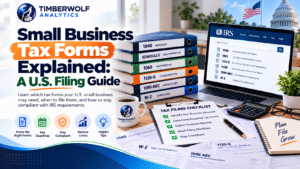
Preparing taxes can be challenging for small business owners, especially when they need to determine which forms apply to their business structure, employees, contractors, and income. Using the wrong form or overlooking a filing requirement can lead to delays, additional costs, and unnecessary stress.
The good news is that understanding the main small business tax forms makes tax preparation more manageable. Once you know which forms apply to your business, you can organize your financial records, track deadlines, and prepare the information needed for filing.
Your business structure is one of the most important factors in determining which forms you need. A sole proprietor generally reports business income differently from a partnership or corporation. Employers also have separate responsibilities for payroll and information reporting.
This guide explains common tax forms for small businesses in the USA, what they are used for, and how accurate bookkeeping can help you prepare for tax season.
Why Do Small Businesses Need Different Tax Forms?
There is no single tax form that applies to every small business. Federal tax requirements depend on factors such as your legal structure, business income, payroll, and certain transactions.
For example, a sole proprietor may report business income on an individual income tax return, while a partnership generally files a separate information return. An S corporation has its own reporting requirements, and businesses with employees must handle employment tax forms.
Your state or local government may also require additional returns, registrations, or payments.
Before preparing your return, identify three things:
Business structure: Are you a sole proprietor, partnership, LLC, S corporation, or C corporation?
Business activities: Do you employ workers, hire independent contractors, sell taxable goods, or operate in multiple states?
Tax obligations: Which federal, state, and local filing requirements apply to your activities?
If you need help keeping financial records organized before filing, TimberWolf Analytics offers bookkeeping services for small businesses.
1. Form 1040 and Schedule C: For Sole Proprietors
Sole proprietors typically report business profit or loss on Schedule C, which is filed with Form 1040, the individual federal income tax return.
A single-member LLC that is treated as a disregarded entity for federal income tax purposes generally follows similar reporting rules, unless it has elected a different tax classification.
What Is Schedule C?
Schedule C, Profit or Loss From Business, reports the business’s income and deductible expenses. The information helps determine the net profit or loss from business operations.
Common items reported on Schedule C include:
Gross receipts and sales
Returns and allowances
Cost of goods sold, where applicable
Advertising and marketing expenses
Business insurance
Office expenses and supplies
Professional fees
Business-related vehicle expenses, when eligible
Other allowable business expenses
For example, suppose a freelance consultant earns $85,000 in business revenue and has $25,000 in eligible business expenses. The resulting net profit is $60,000 before considering any other applicable adjustments.
The actual taxable amount and final tax liability depend on the owner’s complete tax situation.
Why Accurate Records Matter
Schedule C depends on reliable records of income and expenses. Missing receipts, incomplete bank reconciliations, or mixing personal and business transactions can make reporting more difficult.
Maintain organized records throughout the year instead of trying to reconstruct everything immediately before filing. If transactions have fallen behind, TimberWolf Analytics’ catch-up bookkeeping services can help bring financial records up to date.
2. Schedule SE: Self-Employment Tax
Business owners who meet the applicable requirements may need to file Schedule SE, Self-Employment Tax, to calculate Social Security and Medicare taxes on net earnings from self-employment.
Self-employment tax is separate from federal income tax. As a general rule, self-employed individuals calculate this tax using their net earnings from qualifying business activities, subject to applicable rules and thresholds.
Who May Need Schedule SE?
You may need to review Schedule SE if you operate as a sole proprietor or have other qualifying self-employment income.
The filing requirement depends on your circumstances, including your net earnings and any applicable exceptions.
What Should You Prepare?
Before calculating self-employment tax, organize:
Your completed business income and expense records
Your Schedule C information, if applicable
Relevant prior-year tax records
Details of other income or adjustments that may affect your return
Do not assume that paying income tax automatically covers self-employment tax. They are different tax calculations, and both may apply.
3. Form 1065: Partnership Tax Return
Most domestic partnerships generally file Form 1065, U.S. Return of Partnership Income. The form reports the partnership’s income, deductions, gains, losses, and other relevant tax information.
A partnership generally passes its income and other tax items through to its partners rather than paying federal income tax on those items as a corporation would. Partners generally use information from their Schedule K-1 to report their respective shares on their own returns.
Records Partnerships Should Maintain
Partnerships should maintain clear records of:
Business revenue and expenses
Contributions made by each partner
Distributions to partners
Partnership loans and liabilities
Ownership percentages and changes
Supporting documents for deductions and other reported items
Accurate bookkeeping is particularly important when multiple owners share business income, expenses, and financial responsibilities.
Business owners can explore TimberWolf Analytics’ financial services to learn more about support for organizing business finances and improving financial visibility.
4. Form 1120-S: S Corporation Tax Return
An eligible business that has elected S corporation tax treatment generally files Form 1120-S, U.S. Income Tax Return for an S Corporation.
The return reports the corporation’s financial and tax information. Shareholders generally receive Schedule K-1, which shows their shares of applicable income, deductions, credits, and other items.
What Makes S Corporation Reporting Different?
S corporations have specific reporting and compliance requirements. Owners who work for the business may also need to consider reasonable compensation and payroll obligations.
The business should maintain accurate records of:
Revenue and operating expenses
Shareholder contributions and distributions
Payroll and compensation
Business assets and depreciation information
Loans between shareholders and the corporation
Information required for shareholder reporting
S corporation status does not eliminate the need for careful bookkeeping or payroll compliance. Incomplete records can make it harder to prepare the return and explain transactions.
5. Form 1120: C Corporation Income Tax Return
A domestic C corporation generally files Form 1120, U.S. Corporation Income Tax Return, to report its income, deductions, and tax liability.
Unlike the usual federal income tax treatment of partnerships and S corporations, a C corporation generally pays federal corporate income tax on its taxable income. Shareholders may also have tax consequences when the corporation distributes dividends.
Important Records for C Corporations
C corporations should maintain organized records covering:
Sales and other business income
Operating costs and deductible expenses
Payroll and employee benefits
Equipment purchases and depreciation
Interest and other financial costs
Corporate distributions and shareholder transactions
The specific forms and schedules required depend on the corporation’s activities and circumstances. Keep financial statements and supporting documentation consistent with the figures reported on the return.
6. Form W-2 and Form W-4: Employee Payroll Forms
Businesses with employees have responsibilities beyond filing an annual income tax return.
Two important payroll forms are Form W-4 and Form W-2.
Form W-4
Employees generally complete Form W-4, Employee’s Withholding Certificate, to provide information used by their employer to determine federal income tax withholding from wages.
Employers should collect and maintain the necessary employee information and apply the appropriate withholding rules.
Form W-2
Employers generally provide Form W-2, Wage and Tax Statement, to employees and submit the required copies to the Social Security Administration. It reports wages and relevant tax withholding for the year.
Payroll records should reconcile with the amounts reported on W-2 forms and applicable payroll tax returns.
If your small business has employees, do not treat payroll documentation as an afterthought. Incorrect wage records or inconsistent withholding information can create additional work during tax season.
7. Forms 941 and 940: Employment Tax Reporting
Employers may also need to file Form 941 and Form 940, depending on their payroll obligations.
Form 941
Form 941, Employer’s Quarterly Federal Tax Return, is generally used by employers to report federal income tax withheld from employees’ wages and the employer and employee shares of Social Security and Medicare taxes.
Employers must reconcile payroll information, deposits, and reported tax amounts according to applicable requirements.
Form 940
Form 940, Employer’s Annual Federal Unemployment (FUTA) Tax Return, is used to report federal unemployment tax when the employer meets the applicable filing requirements.
FUTA tax is generally an employer tax, and eligibility for credits and other rules can affect the amount due.
Keep payroll registers, wage records, tax deposits, and filed returns together. Reviewing these records regularly can help identify discrepancies before annual reporting deadlines.
8. Form 1099-NEC: Payments to Independent Contractors
Businesses may need to file Form 1099-NEC, Nonemployee Compensation, to report certain payments made to independent contractors and other qualifying service providers.
Whether a business must issue the form depends on factors such as the payment type, recipient, amount, and applicable reporting rules for the tax year.
What Should Business Owners Track?
Maintain records of:
Contractor names and business details
Completed Forms W-9, where appropriate
Payments made during the year
Invoices and service agreements
Payment dates and methods
Whether a payment is reportable under the applicable rules
Do not assume every payment to a contractor belongs on Form 1099-NEC. Some payments are subject to different reporting rules or exceptions.
Also, the form used for reporting a payment does not by itself determine whether a worker is an employee or an independent contractor. Worker classification must be evaluated separately.
9. Form 1099-MISC: Certain Other Payments
Form 1099-MISC is used to report certain types of payments that are not generally reported as nonemployee compensation on Form 1099-NEC.
Depending on the transaction and current reporting rules, this may include certain rents, awards, prizes, or other reportable payments.
Businesses should categorize transactions correctly throughout the year so they can identify which information returns may be required.
Review payment records before filing and confirm the applicable reporting thresholds and exceptions for the relevant tax year.
10. Form 1040-ES: Estimated Tax Payments
Some business owners need to make estimated tax payments during the year rather than waiting until they file their annual return.
Form 1040-ES, Estimated Tax for Individuals, helps individuals calculate and pay estimated federal income tax. It may be relevant to sole proprietors, partners, and certain other taxpayers whose income is not subject to sufficient withholding.
Estimated payments may cover both income tax and self-employment tax, depending on the taxpayer’s situation.
How Can You Prepare?
Start by reviewing:
Year-to-date business income
Deductible expenses
Previous tax returns
Expected changes in revenue
Other income and withholding
Estimated tax payments already made
Cash flow forecasting can help you anticipate when money will be available for tax payments. However, a cash flow forecast is a planning tool, not a substitute for calculating your tax obligations.
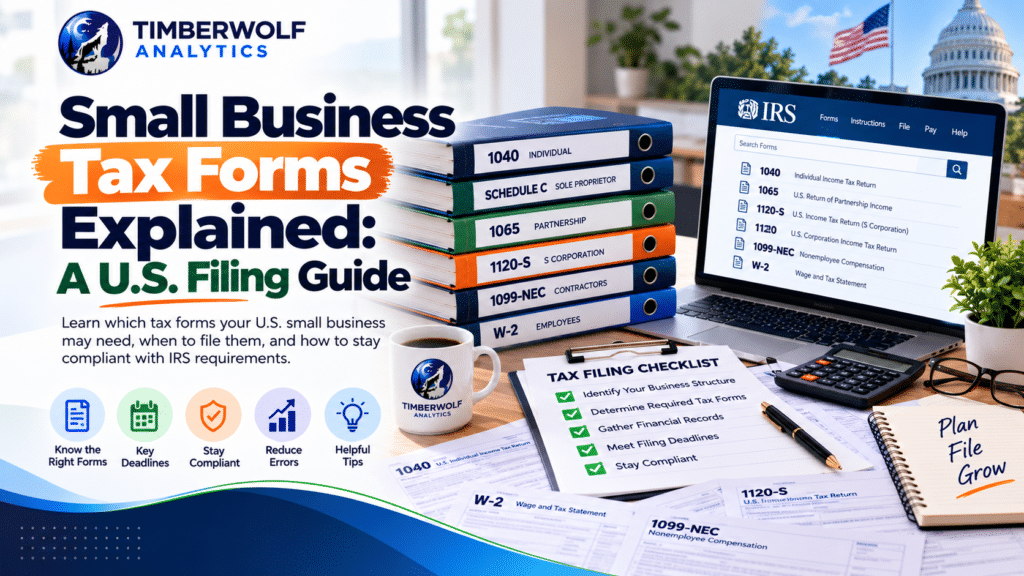
Small Business Tax Forms Checklist
Use this checklist to organize your records before tax preparation.
Confirm your business structure and federal tax classification.
Gather bank statements and business credit card statements.
Reconcile business accounts and review outstanding transactions.
Organize sales records, invoices, and other income documentation.
Categorize expenses and retain supporting receipts.
Review contractor payments and relevant Forms W-9.
Gather prior-year tax returns and estimated payment records.
Identify applicable federal, state, and local filing requirements.
Review the forms and filing deadlines relevant to your business.
Retain copies of submitted returns and supporting documents.
If your records are incomplete or transactions have not been categorized consistently, resolve those issues before relying on the numbers for tax filing.
How Bookkeeping Makes Small Business Tax Filing Easier
Tax preparation becomes more manageable when your financial records are accurate throughout the year. Good bookkeeping helps business owners understand where money comes from, where it goes, and which transactions need additional documentation.
It also reduces the need to reconstruct financial activity under deadline pressure.
A consistent bookkeeping process should include recording transactions, reconciling bank accounts, tracking income and expenses, reviewing outstanding invoices, and maintaining supporting documents.
These activities help create a more reliable foundation for tax preparation. They can also give owners better insight into operating costs, profitability, and available cash.
TimberWolf Analytics provides bookkeeping services to help businesses maintain organized financial records. Businesses that need to address historical gaps can also review its catch-up bookkeeping guide.
For businesses seeking additional support with tax preparation, visit TimberWolf Analytics’ tax preparation services.
The right support depends on your business needs, the condition of your records, and the services available to you. Confirm the scope of any service before relying on it for a particular filing requirement.
Common Mistakes to Avoid When Preparing Business Tax Forms
Even organized businesses can make mistakes when preparing tax returns. The following practices can help reduce avoidable problems.
Mixing personal and business expenses: Separate accounts make it easier to identify business transactions and support legitimate deductions.
Choosing forms without checking tax classification: An LLC’s legal structure does not automatically determine how it is taxed federally. Confirm its tax classification before selecting a return.
Ignoring payroll and contractor reporting: Businesses may have information-return and employment-tax obligations in addition to their annual income tax return.
Relying on estimates instead of actual records: Use reconciled financial information and supporting documentation wherever possible.
Missing state and local requirements: Federal forms do not cover every tax obligation. Requirements vary by jurisdiction and business activity.
Waiting until the filing deadline to organize records: Regular monthly reviews can help identify missing documents and inconsistencies early.
Assuming every expense is deductible: The tax treatment of an expense depends on the applicable rules and the facts of the transaction. Maintain documentation and seek qualified advice when necessary.
Conclusion
Understanding small business tax forms is an important step toward more organized and reliable business tax filing in the USA. The forms you need depend on your business structure, income, employees, contractor payments, and other activities.
Sole proprietors may need Form 1040 with Schedule C and, where applicable, Schedule SE. Partnerships generally file Form 1065, while S corporations and C corporations typically use Forms 1120-S and 1120, respectively. Businesses with employees or qualifying contractor payments may also have separate reporting responsibilities.
The most effective preparation starts before tax season. Keep your financial records current, reconcile accounts regularly, retain supporting documents, and identify filing requirements well in advance.
If your business needs help organizing its records, improving financial visibility, or preparing for tax season, explore TimberWolf Analytics’ financial services to see whether its services fit your needs.
Important note: This article provides general educational information, not individualized tax or legal advice. Tax forms, thresholds, deadlines, and reporting rules can change. Verify requirements for the relevant tax year with the IRS and your state tax agency, or consult a qualified tax professional.
Frequently Asked Questions
What tax forms does a small business need in the USA?
The required forms depend on the business’s tax classification and activities. Sole proprietors commonly use Form 1040 with Schedule C. Partnerships generally file Form 1065, S corporations generally file Form 1120-S, and C corporations generally file Form 1120. Employers and businesses paying contractors may have additional reporting requirements.
Does an LLC need to file a separate business tax return?
Not necessarily. A single-member LLC is generally treated as a disregarded entity for federal income tax purposes unless it elects otherwise. Multi-member LLCs are generally treated as partnerships by default unless they elect corporate tax treatment. The applicable filing requirements depend on the LLC’s tax classification and circumstances.
What forms do small businesses use for employees?
Employers commonly use Form W-4 for employee withholding information and Form W-2 for annual wage and withholding reporting. They may also need Form 941, Form 940, and other payroll-related forms, depending on their obligations.
What is the difference between Form 1099-NEC and Form 1099-MISC?
Form 1099-NEC generally reports qualifying nonemployee compensation. Form 1099-MISC covers certain other reportable payments, such as some rents and awards. The correct form depends on the payment type and the applicable reporting rules.
How can bookkeeping help with business tax filing?
Bookkeeping helps maintain organized records of income, expenses, payroll, and other transactions. Reconciled accounts and supporting documentation make it easier to prepare tax returns, investigate discrepancies, and substantiate reported amounts.
When should a small business start preparing its tax forms?
Businesses should maintain records throughout the year and begin reviewing their filing requirements well before applicable deadlines. Monthly reconciliations and regular financial reviews can reduce the workload when tax preparation begins.