As a business grows, financial decisions become more complex. Bookkeeping and accounting keep financial records organised, but growing companies often need someone who can look beyond historical numbers to support cash flow, forecasting, profitability, budgeting, and long term strategy.
That is where a Fractional CFO or Virtual CFO can help.
Although these terms are sometimes used interchangeably, they do not necessarily describe the same thing. The key distinction is that “fractional” generally refers to the engagement structure, while “virtual” refers to how the service is delivered. A CFO can, in fact, be both fractional and virtual.
Understanding that difference can help small business owners choose financial leadership based on their actual needs rather than simply choosing the most familiar title.
What Is a Fractional CFO?
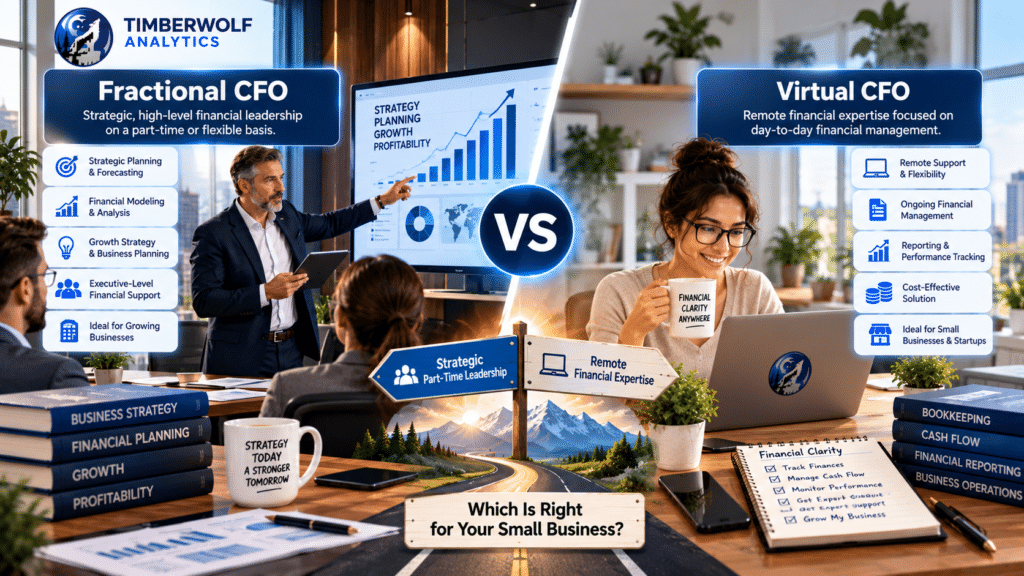
A Fractional CFO is an experienced financial executive who works with a business on a part time, flexible, or otherwise limited engagement instead of serving as a full time CFO.
- Cash flow forecasting
- Financial planning and budgeting
- Profitability analysis
- Financial modeling
- KPI reporting
- Scenario planning
- Growth strategy
- Working capital management
- Financing preparation
- Management decision support
The key difference between a Fractional CFO and a bookkeeper lies in the level of responsibility. A bookkeeper primarily maintains accurate financial records, while a CFO uses financial information to help management make forward-looking decisions.
TimberWolf Analytics describes its Fractional CFO work around financial forecasting, budgeting, profitability analysis, KPI reporting, strategic planning, and related financial decision support.
For a deeper explanation, see TimberWolf Analytics’ Fractional CFO guide for small businesses.
What Is a Virtual CFO?
A Virtual CFO provides CFO level financial guidance primarily through remote communication and digital tools.
- Financial reporting
- Cash flow forecasting
- Budgeting
- Financial analysis
- KPI dashboards
- Strategic planning
- Financial modeling
- Business advisory
Cloud accounting platforms, video meetings, digital dashboards, and shared financial systems enable a CFO to work with a business without being physically present in the office.
This makes a Virtual CFO particularly useful for companies that already operate remotely or are comfortable managing financial collaboration online.
TimberWolf Analytics also offers Virtual CFO solutions alongside Fractional CFO, bookkeeping, reporting, and cash-flow services.
Fractional CFO vs Virtual CFO: What’s the Difference?
The easiest way to understand the relationship is to separate engagement from delivery.
| Main concept | Engagement structure | Delivery method |
| Schedule | Usually part-time or flexible | Varies |
| Location | Remote, hybrid, or sometimes on-site | Primarily remote |
| Financial strategy | Yes | Yes |
| Cash flow forecasting | Yes | Yes |
| Financial reporting | Yes | Yes |
| KPI analysis | Yes | Yes |
| Budgeting | Yes | Yes |
| Strategic advisory | Yes | Yes |
| Can overlap? | Yes | Yes |
This distinction matters because Fractional and Virtual are not necessarily competing categories.
A business could hire a Virtual Fractional CFO who works remotely for 10 15 hours per week. That person is both fractional and virtual.
Some providers make a sharper distinction between the two models, while others recognise that the terms can overlap. The underlying services and engagement should therefore be evaluated rather than relying only on the title.
What Services Can Both CFO Models Provide?
For many small businesses, the actual value comes from the work being performed rather than whether the CFO is called “virtual” or “fractional.”
Cash Flow Forecasting
A CFO can analyse expected cash inflows and outflows to identify potential shortages and help management plan ahead.
Financial Reporting
Monthly financial reports can become more useful when someone interprets the numbers rather than simply producing them.
Budgeting and Forecasting
A CFO can compare actual performance with budgets and adjust financial assumptions as the business changes.
Profitability Analysis
Revenue growth does not automatically mean stronger profits. CFO level analysis can identify margin problems, rising costs, or underperforming areas.
KPI Management
Financial KPIs can help owners monitor revenue growth, margins, operating cash flow, working capital, and other indicators.
Strategic Planning
The U.S. Small Business Administration also emphasises maintaining proper bookkeeping and understanding business finances as important foundations for managing a company.
When Is a Fractional CFO the Better Choice?
A Fractional CFO may be a strong fit when your business needs ongoing executive-level financial involvement without hiring a full time CFO.
- Your company is growing quickly
- Financial complexity is increasing
- Cash flow is difficult to predict
- Profitability is not keeping pace with revenue
- You are preparing for financing
- You need regular financial strategy meetings
- You are planning an expansion
- Leadership needs help interpreting financial information
- You need stronger financial controls and forecasting
The deciding factor should not be a specific revenue threshold. Two businesses with identical revenue can have completely different financial needs.
A service business with simple operations may need less CFO involvement than a rapidly growing company with multiple locations, complex pricing, inventory, debt, or outside investors.
When Is a Virtual CFO the Better Choice?
A Virtual CFO may be especially suitable when remote collaboration is already part of the way your business operates.
- Remote or distributed teams
- Cloud based accounting systems
- Multiple locations
- Digital workflows
- Owners who prefer virtual meetings
- A need for flexible financial support
The important point is that remote delivery does not automatically mean less strategic involvement.
A Virtual CFO can still participate in financial planning, forecasting, KPI reviews, profitability analysis, and major business decisions.
Can a CFO Be Both Virtual and Fractional?
This is one of the most important points for business owners to understand.
Imagine a growing company needs a CFO for two days per week. The CFO works remotely, reviews the company’s financial reports, prepares cash flow forecasts, attends monthly leadership meetings, and advises the owner on expansion.
Therefore, asking “Should I choose a Fractional CFO or a Virtual CFO?” can sometimes be the wrong question.
What level of financial leadership does my business need, and how should that support be delivered?
Fractional CFO vs Virtual CFO vs In House CFO
There is also a third option: hiring an in house CFO.
In House CFO
Best suited to: Larger or highly complex businesses that require dedicated internal financial leadership.
Fractional CFO
Virtual CFO
These categories can overlap. For example, a Fractional CFO can also be Virtual.
How to Choose the Right CFO Service for Your Business
Instead of choosing based only on the title, evaluate these factors.
Business Complexity
Strategic Needs
Level of Involvement
Remote vs In Person Collaboration
Financial Goals
Reporting Requirements
Forecasting Needs
Business Stage
Your needs will change as the business moves from startup to growth and, eventually, to greater operational complexity.
What Should the Right CFO Service Include?
When comparing Fractional CFO companies or best Virtual CFO services, look beyond the title.
- Accurate financial reporting
- Cash flow forecasting
- Budgeting
- Financial modeling
- KPI dashboards
- Profitability analysis
- Scenario planning
- Working capital guidance
- Strategic financial meetings
- Actionable recommendations
A dashboard full of numbers is not a strategy.
The real value comes from understanding what the numbers mean and deciding what should happen next.
Why Bookkeeping Still Matters
CFO-level strategy depends on reliable financial information.
If transactions are incomplete, accounts are unreconciled, or financial reports are inaccurate, even an experienced CFO may struggle to produce useful analysis.
TimberWolf Analytics combines Fractional CFO services, Virtual CFO solutions, outsourced bookkeeping, financial reporting, cash flow forecasting, and business advisory support.
Final Verdict: Which One Is Right for Your Business?
If you primarily need remote CFO support, a Virtual CFO may be a good fit for your operating model.
Your decision should ultimately be based on financial complexity, strategic goals, required involvement, forecasting needs, and your team’s way of working.