Sales tax can become complicated quickly when a small business sells products or services across different states, operates an online store, or begins reaching customers outside its home market.
The basic concept is simple: a business may be required to collect sales tax from customers on taxable transactions and then report and remit that tax to the appropriate state or local tax authority. The difficult part is determining when sales tax applies, where a business must register, which transactions are taxable, how much tax to collect, and when returns and payments are due.
For small businesses in 2026, understanding sales tax is especially important because obligations can vary by state, locality, product, service, and the business’s connection to a jurisdiction.
This guide explains the fundamentals of sales tax for small businesses, including registration, nexus, rates, online sales, exemptions, use tax, filing, and recordkeeping.
What Is Sales Tax for Small Businesses?
Sales tax is generally a consumption tax imposed on taxable sales of goods and, in some jurisdictions, certain services. The customer typically bears the tax, while the business acts as the collector and remits the amount to the applicable tax authority.
Sales tax is different from federal income tax.
For example, sales tax collected from customers generally should not be treated as ordinary business revenue. The business is collecting money that may need to be passed to a state or local government.
The exact rules depend on the jurisdiction where the transaction is taxable.
Do Small Businesses Have to Collect Sales Tax?
Not every business has the same sales tax obligations.
A business generally needs to determine whether it has a sufficient connection, known as sales tax nexus, with a state or other taxing jurisdiction and whether the products or services it sells are taxable there.
Nexus can arise from factors such as:
A physical business location
Employees or other personnel
Inventory or property
Certain business activities
Sales into a state that meet an applicable economic threshold
Economic nexus is particularly important for online businesses because a company can potentially create sales tax obligations in a state without maintaining a traditional office there.
Because nexus standards differ by jurisdiction, a small business should evaluate each state separately rather than assuming that one rule applies nationwide.
What Is Sales Tax Nexus?
Sales tax nexus is the connection between a business and a taxing jurisdiction that can create an obligation to register, collect, and remit sales tax.
For a small business, nexus may be created through physical presence or economic activity, depending on the state’s rules.
For example, a business might operate from one state but sell substantial amounts of merchandise to customers in another state. If the business meets that state’s applicable economic nexus requirements, it may have to register and begin collecting sales tax there.
Nexus is one of the most important concepts to understand before expanding an online or multi-state business.
How to Register for a Sales Tax License
If your business has a sales tax obligation in a state, you generally need to register with the appropriate state tax authority before collecting sales tax.
The registration process can vary, but businesses commonly need information such as:
Legal business name
Business structure
Employer Identification Number
Business address
Owner or responsible-party information
Description of business activities
Expected sales activity
Information about locations or other nexus factors
Some states use terms such as sales tax permit, seller’s permit, or sales tax license.
Do not assume that registering in one state automatically registers your business everywhere else. Multi-state businesses may have separate registration requirements.
How Much Sales Tax Should a Small Business Charge?
There is no single nationwide sales tax rate that every U.S. small business should use.
The applicable rate can depend on the state, locality, transaction type, and the rules governing where the sale is sourced.
Some jurisdictions also have local sales taxes in addition to a state-level rate.
For this reason, businesses should use current state and local tax information or an appropriate tax calculation system rather than relying on an old rate stored in a spreadsheet.
If your business sells across multiple jurisdictions, automated tax calculation can reduce the risk of manually maintaining changing rates.

What Products and Services Are Subject to Sales Tax?
Taxability depends on the jurisdiction and the type of transaction.
Common examples that may require review include:
Physical products
Digital products
Software
Food and beverages
Clothing
Equipment
Rentals
Professional services
Labor
Installation services
Subscription-based products or services
A product that is taxable in one state may be exempt or treated differently in another.
The same principle can apply to services. Some states tax certain services while others do not.
Therefore, businesses should not assume that a product or service is taxable or exempt everywhere simply because it receives a particular tax treatment in one state.
Sales Tax on Online and Out-of-State Sales
Online selling has made sales tax compliance more complex for many small businesses.
A business may sell through:
Its own website
Shopify or another ecommerce platform
Online marketplaces
Social commerce platforms
B2B ordering systems
Subscription platforms
Selling online does not automatically mean that sales tax is due in every state. The business must determine where it has nexus and whether the specific transactions are taxable.
Marketplace facilitator rules can also affect who is responsible for collecting and remitting tax on marketplace transactions.
Businesses selling online should therefore understand both their direct sales obligations and the tax responsibilities handled by marketplaces or payment platforms.
Sales Tax vs. Use Tax: What’s the Difference?
Sales tax and use tax are closely related but serve different purposes.
Sales tax is generally collected from the customer at the time of a taxable sale.
Use tax can apply when taxable property is purchased without the appropriate sales tax being collected and the property is later used, stored, or consumed in a jurisdiction where use tax applies.
For example, a business may purchase taxable equipment from an out-of-state seller that does not collect the applicable tax. Depending on the jurisdiction and circumstances, the business may have a use tax obligation.
Understanding the difference between sales and use tax is important because a business cannot assume that no tax was due simply because the seller did not charge sales tax.
When Is Sales Tax Due?
Sales tax filing and payment deadlines are determined by the applicable state or local tax authority.
A business may be assigned a filing frequency based on factors such as its tax liability, sales activity, or jurisdictional requirements.
Depending on the jurisdiction, a business may file:
Monthly
Quarterly
Annually
Under another assigned reporting schedule
The important point is to follow the filing schedule assigned to your business.
Registered businesses may also have filing obligations for a reporting period even when they have no sales or no tax due, depending on the jurisdiction.
Missing a filing deadline can result in penalties, interest, notices, or other compliance problems.
How to Calculate and File Sales Tax
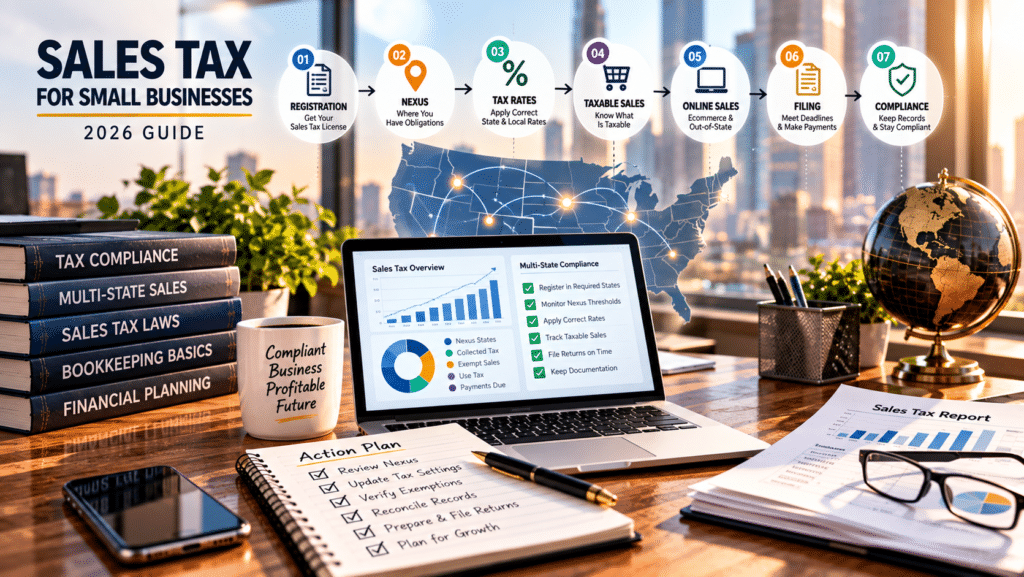
A basic sales tax process can be organized into several steps.
Step 1: Identify Taxable Sales
Determine which transactions are subject to sales tax under the applicable rules.
Step 2: Determine the Correct Rate
Apply the appropriate state and local rate based on the transaction and sourcing rules.
Step 3: Track Tax Collected
Keep sales tax collected separate from business revenue in your accounting records.
Step 4: Reconcile Your Records
Compare sales transactions, invoices, tax collected, refunds, exemptions, and accounting records.
Step 5: File the Required Return
Submit the appropriate sales tax return through the relevant state system by the assigned deadline.
Step 6: Remit the Tax
Pay the amount due according to the state’s payment instructions.
Step 7: Keep Supporting Records
Maintain invoices, exemption certificates, transaction records, returns, payment confirmations, and other documentation required by the applicable jurisdiction.
Sales Tax Exemptions and Resale Certificates
Not every transaction is taxable.
States may provide exemptions for certain products, customers, organizations, or types of purchases.
Businesses may also encounter resale certificates, which can allow qualifying purchases intended for resale to receive different tax treatment.
However, exemption rules and documentation requirements vary.
A business should verify that an exemption applies and maintain the required documentation instead of simply marking a transaction as tax-exempt.
Poor exemption documentation can create problems during an audit.
Common Sales Tax Mistakes Small Businesses Make
Sales tax mistakes often happen because businesses treat compliance as a one-time setup task.
Common problems include:
Using the Wrong Tax Rate
Rates can vary by jurisdiction and transaction, and they can change over time.
Ignoring Economic Nexus
An online business may create obligations in another state through sales activity even without a physical storefront there.
Missing Filing Deadlines
A business that collects sales tax needs a process for tracking every filing and payment deadline.
Mixing Sales Tax With Revenue
Sales tax collected from customers should be properly recorded rather than treated as business income.
Failing to Track Exemptions
Businesses should maintain documentation supporting tax-exempt transactions and resale certificates.
Relying Entirely on Spreadsheets
Manual systems can become difficult to manage as transaction volume and the number of jurisdictions increase.
Ignoring State Notices
Tax notices should not be ignored. Businesses should review them promptly and determine whether a response, payment, correction, or professional assistance is required.
How Bookkeeping Helps With Sales Tax Compliance
Good sales tax management depends on accurate financial records.
Businesses need reliable records of sales, refunds, customer payments, taxable transactions, exemptions, and tax collected.
This is where bookkeeping for small businesses becomes more than simply recording transactions.
Organized bookkeeping can make it easier to reconcile sales, identify discrepancies, prepare financial reports, and provide the documentation needed for tax-related work.
Businesses that have fallen behind on their books may also need to bring their records up to date before they can confidently assess their tax position.
How Sales Tax Affects Small Business Cash Flow
Sales tax can also affect cash management.
Because businesses may collect tax from customers before remitting it to the tax authority, the money can temporarily appear in the business bank account even though it is not available for ordinary operating expenses.
Using collected sales tax to fund payroll, marketing, inventory, or other expenses can create a cash-flow problem when the payment deadline arrives.
A better approach is to account for sales tax liabilities separately and include upcoming tax payments in the business’s cash flow planning.
This is especially important for businesses with large fluctuations in sales.
When Should a Small Business Get Professional Help?
Sales tax becomes more difficult when a business operates in multiple states, sells online, handles large transaction volumes, offers a mix of taxable and exempt products, or receives tax notices.
Professional support can help a business organize its financial records, understand its obligations, reconcile transactions, and integrate tax-related requirements with broader financial planning.
It is also important to distinguish financial management support from legal or tax advice. State-specific sales tax questions should be verified with the applicable state tax authority or a qualified tax professional.
For businesses that need broader financial visibility, a Fractional CFO can also help connect financial reporting, cash flow management, forecasting, budgeting, and strategic planning.
Frequently Asked Questions
What is sales tax for small businesses?
Sales tax is generally a state or local consumption tax collected on taxable sales. A business that has an applicable sales tax obligation typically collects the tax from customers and remits it to the relevant tax authority.
Do all small businesses have to collect sales tax?
No. Requirements depend on factors such as the business’s nexus with a jurisdiction, the type of products or services sold, and applicable state and local rules.
What is sales tax nexus?
Sales tax nexus is a sufficient connection between a business and a taxing jurisdiction that can create sales tax registration and collection obligations.
Do online businesses have to collect sales tax?
An online business may have sales tax obligations in states where it has nexus. Economic activity can create nexus even when the business has no traditional physical location in that state.
What is the difference between sales tax and use tax?
Sales tax is generally collected by the seller on a taxable transaction. Use tax can apply when taxable property is purchased without the required sales tax and is subsequently used, stored, or consumed in a jurisdiction where use tax applies.
When is sales tax due?
Sales tax filing and payment deadlines vary by jurisdiction and the filing schedule assigned to the business. Businesses should follow the deadlines provided by the relevant state or local tax authority.
How should a small business keep track of sales tax?
Maintain organized records of taxable sales, tax collected, exemptions, refunds, invoices, payments, returns, and supporting documentation. Accounting software and automated tax tools can help as transaction volume increases.
Final Thoughts
Sales tax for small businesses is not simply a matter of adding a percentage to every customer invoice.
The real challenge is understanding where your business has an obligation, which transactions are taxable, what rate applies, when you must register, how often you must file, and how to maintain accurate records.
For 2026, small businesses should pay particular attention to online sales, multi-state activity, economic nexus, exemption documentation, filing deadlines, and the growing need for reliable sales tax processes.
Start with the states and jurisdictions where your business operates or sells, determine whether nexus exists, verify the current rules, and build a repeatable process for calculating, recording, filing, and remitting sales tax.
Most importantly, keep sales tax compliance connected to accurate bookkeeping and broader financial management. When your financial records are organized and your tax liabilities are visible, it becomes much easier to plan cash flow, avoid surprises, and make confident business decisions.